Sunday, 26 January 2014

Chair Club Part 2 - building up the surface


It took a while to position and set the various woods on the top surface of my chair, but once this was complete, I took my stool top to the band saw and trimmed it square.
 
The woods I have the privilege of including in making my chair are a combination of cheap and durable, and expensive and durable. Every piece has been salvaged locally, or donated kindly to the cause by our teacher Richard.

Woods:

Iroko (Milicia excelsa) - origins in Tropical Africa, a medium wood that darkens over time. Very durable and resistant to termite attack which is always welcome.

Panga Panga (Millettia stuhlmannii) - a rich African wood, very dark brown with black streak. I think it looks like beautiful dark hair when polished up! Another termite avoider. 

 
  - on target for a super durable multi-wood stool!

The other main wood I have used for the surface is multi-layer plywood, a particularly fashionable material in contemporary design (you may have noticed). This was salvaged by Kira and I, although would have been v.cheap had we bought it. It is multi plies of birch veneer which results in a wood that is tough, and I think, very interesting to look at. 


- some designers do great things with this plywood > 


Meanwhile, Kira's miniature chair was being painstakingly cut. Each leg angle was cleverly chosen, kindred to a retro Scandinavian dining chair.


Wednesday, 22 January 2014

Chair Club part 1

There are some key rules in Chair Club. The first rule is that Chair Club is not open to new members - we are sorry for this but hopefully this Chair Club will inspire another chair club!

We have met and made chairs on Tuesday evenings for the past 4/5 months, often followed by a Street Food Chef burrito. Chair making is hungry work.

The second rule is Chair Club is not exclusive to chair making. Now that we have reached the penultimate session - my "milking stool" (four legged so it doesn't technically qualify) is almost ready for an oil finish - we are speculating about season two of Chair Club, and it might involve metal, and creating non-functional things.

Here's a short diary of Chair Club, in pictures; myself, Kira Askaroff and the brilliant Richard Bartle, chieftain of Chair Club.

Part 1 

Preliminary sketches done, I decided to make a short stool for my bedroom dresser, akin to a milking stool but four legged.


Kira opted to create a miniature chair, inspired by a series of miniature furniture that Richard made for a previous project Deities at the Bottom of the Garden (a series of twelve exquisitely and accurately rendered scale models of a typical garden shed, each containing the interior of a different temple or church).

We selected our materials - mine combines various woods on the surface which will be sanded flat, and the leg joints will be visible on top too. 

Woods; Rose wood, panga panga, multi layer plywood


Glueing the various pieces of timber down.


Wednesday, 1 January 2014

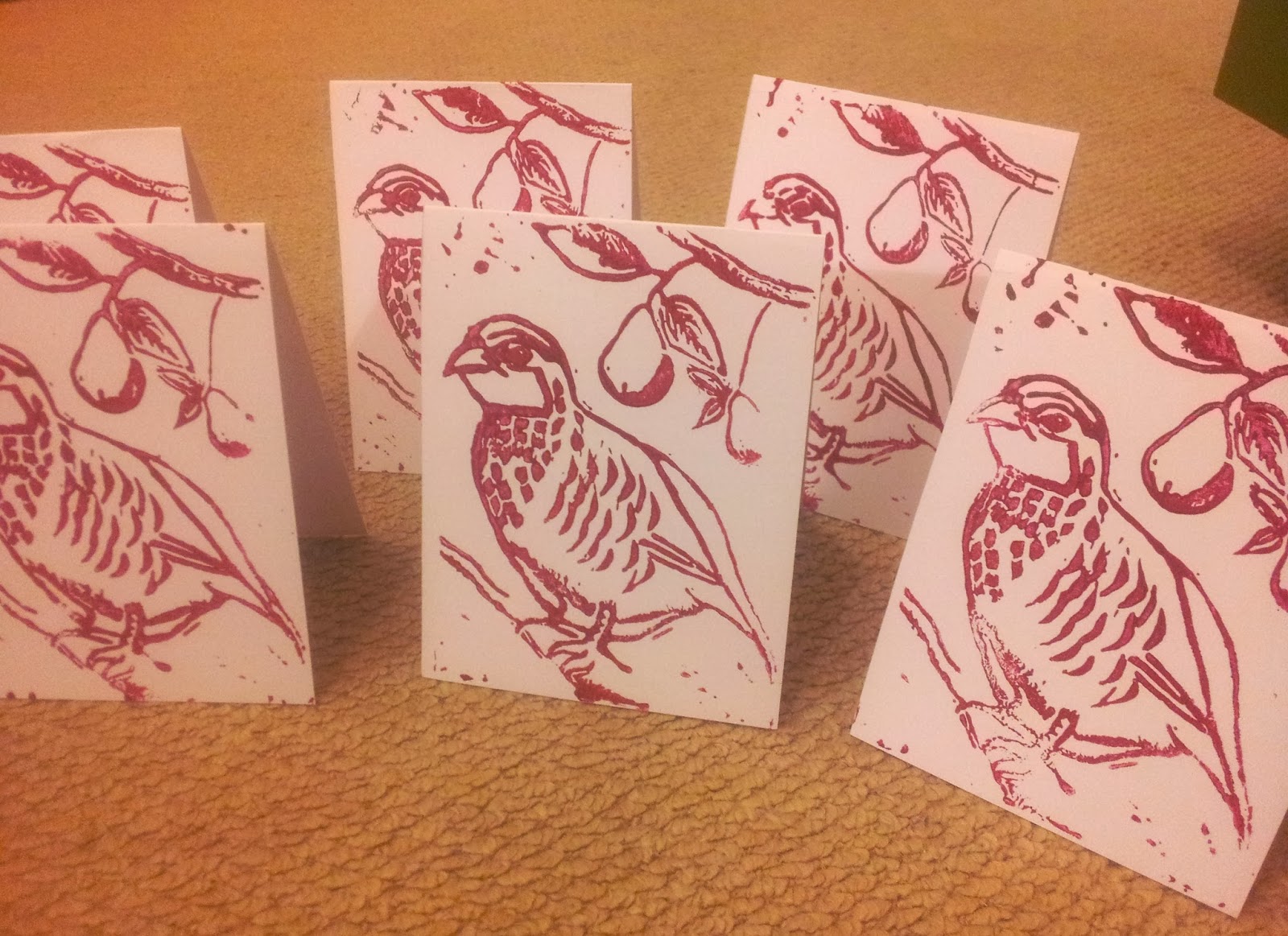
Lino Print Christmas Cards: Partridge in a Pear Tree

Back to the lino board this year! Time to make Christmas cards.

A Partridge in a Pear Tree

Carving


extracts
first set - lino block printing ink


second set

I decided to produce a more detailed lino design than my robin of a previous Christmas. The result is good, though it has been a little tricky to print consistently, as the areas I have carved are variable in depth and smoothness - this matters as much as the neatness of your relief areas.

Also I first used lino specific printing block paint (water based) and the results weren't as smart or sharp as the plum emulsion paint tester pot* that I tried afterwards!  

 * Note: It is not as easy to clean the lino itself after using non-block printing paint.

As usual, here's a look over the Christmas cards I have hand painted / printed in recent years:

2012 - Potato Printed Robin

2011 - Watercolour squirrels, robins scene

2010 - Lino cut Robin prints

2009 - Repeat watercolour Christmas pattern for cards, advent calendar and tags

2008 - Re-interpreted Victorian Christmas Cards - Handpainted


Monday, 9 September 2013

20x20 Access Space - new artwork!


Plate 7. Trapeze, Collaged drawing and painted plate design on board.
for the Access Space 20x20 exhibition Opening Friday 13 September 2013

(20x20 is an open exhibition, with the only prerequisite that every artwork is a 20 inch square)


Friday, 6 September 2013

Top 3 Artworks in Sheffield chosen for Our Favourite Places

" ‘I am to paint several portraits in the country and three ugly women at Sheffield, dingy hole’. 
 John Singer Sargent describing his 'The Misses Vickers', 1884

"Ironically, it turned out to be one of his best and one of Sheffield’s most popular paintings: a modern depiction of three modern, pretty Sheffield women – a cinematic, tense, and ‘chiaroscuro’ (both light and melancholic) masterpiece..."

I was eager to write this feature piece but in practice it proved very tricky. My final shortlist of 'Top 3 Artworks' in Sheffield for Our Favourite Places included two works not currently on public display, and one public sculpture under threat of relocation and worse potentially, of being sold. So it seemed right to stick with this semi-awkward shortlist since it says much about Sheffield's artistic climate.

1. ‘The Misses Vickers’ (1884), John Singer Sargent
2.‘Double Somersault’ (1976), William Pye
3. ‘Election Protest, Bolotnaya Square, Moscow, 2011′, hand embroidery on wool (2012) from the Interpersonal Spatial Arrangements series, Roanna Wells

William Pye, 'Double Somersault', 1976. Photo by Shaun Bloodworth
Sheffield is brimming with artists - it's pretty difficult to be ignorant of the fact. There's an impressive quantity and quality of work being made in studios scattered right across the city, from converted office blocks to suburbs to artist led spaces. Yet there are scarce opportunities to exhibit or participate in projects in the city since its visual arts sector is severely underfunded.

In terms of the city's extraordinary art collection, sadly there is little capacity for display. The public can encounter the collection on semi-rotated display at the Graves gallery (on the very top floor of the central library, sporting limited opening hours) and the Ruskin gallery close by, both are modest in size in contrast to the works which are waiting in the wings (tucked away in storage beneath the Graves gallery). This is said to be a preservation issue, limiting exposure to light, etc.

Ruskin donated a great deal of artworks to Sheffield for the pleasure of the city's workers. Once, Sheffield's art collections displayed for public enjoyment set a fine example to cities like Manchester. Now, Manchester offers an extensive collection on display all year round, in conjunction with contemporary art exhibitions and new commissions.

It isn't an easy problem to solve but it was a pleasure to mark out three fine examples of artworks to be cherished but not hoarded, shared and above all, discussed. Whether visible or not, it's important we're aware of them and the artists that created them here, or dedicated them to us, for our benefit.

Read the piece in full here on Our Favourite Places

Thursday, 15 August 2013

Cushion making

I chose these two fabrics in John Lewis - both are reproductions of classic 1950's prints. After a few initial snags, I taught myself to successfully use my new (old) machine and feel extremely pleased.


The checkerboard fabric is United Colours of Benetton - it has the best colours and seemingly doesn't repeat - an absolute bargain from a fabric shop in Hillsborough. 


Monday, 12 August 2013

The Magic Know-How, Laura Buckley

Beautiful new show at Site Gallery in Sheffield by London based artist Laura Buckley.

Image courtesy of Site Gallery
Image courtesy of Laura Buckley

Image courtesy of Laura Buckley
Image courtesy of Site Gallery


Wednesday, 7 August 2013

Archive Sheffield

Archive Sheffield is a new printed matter, produced in and about Sheffield. It targets and illustrates the people of the city as documented by some of the city's best photographers, and heralds a specially chosen set of projects by presenting them in small, alluring bites.

The core idea of Archive Sheffield that 'Sheffield is not place it is people'. It's first edition includes work by Theo Simpson, Gemma Thorpe, Andy Brown and Clive Egginton. Each photographer is gifted in picking out inconspicuous and lesser celebrated or rarely identified everyday details - details often guilty of provoking grander sensations of contentment, displacement or inspiration in ourselves and in strangers around us.  Ordinarily, we might fail to observe them.

Du.st have designed the neat layout and shape of Archive Sheffield's print - large format newspaper style with an additional smaller sheet of information added to the outside, held in place by a clip, also giving you the option to separate the pages and see the pictures in full.


Gemma Thorpe's photography is particularly engaging derived from her ongoing larger project work with Chinese students in Sheffield, 'Youzi Project'. 'Youzi's (translates to 'wanderers'). Her photographs depict the individual and collective lives of young Chinese people studying in their thousands in the city, adapting rapidly to  a vastly disparate culture and in turn changing the city's cultural fabric.

A hopeful start for Archive Sheffield, working to capture and stimulate thought across a broader spectrum of people,  showing us the city we think we know through alternative lenses.

Copies available across the city, including Site Gallery

Monday, 5 August 2013

The finest example of a pair of Stork scissors


"Chased Stork Scissors" 

I looked into the term 'chased' but it's unclear if 'chased' is a scissor type or more to do with the stork. He looks quite static to me.

 As seen at Sheffield Cutlers Hall